Global Firearms Holdings
Found 0 image(s):
Global Firearms Holdings
Global Firearms Holdings
There are more than one billion firearms in the world, the vast majority of which are in civilian hands.
The Small Arms Survey estimates that of the one billion firearms in global circulation as of 2017, 857 million (85 per cent) are in civilian hands, 133 million (13 per cent) are in military arsenals, and 23 million (2 per cent) are owned by law enforcement agencies. Our studies suggest that the global stockpile has increased over the past decade, largely due to civilian holdings, which grew from 650 million in 2006 to 857 million in 2017.
Find out more in our three briefing papers and navigate our interactive map below for a quick overview of specific country numbers:
- Estimating Global Civilian-held Firearms Numbers. Briefing Paper, June 2018. (See Annexe with data by country/territory.)
- Estimating Global Military-owned Firearms Numbers. Briefing Paper, June 2018. (See Annexe with data by country/territory.)
- Estimating Global Law Enforcement Firearms Numbers. Briefing Paper, June 2018. (See Annexe with data by country/territory.)
See also:
- Press release (18 June 2018)
- Infographics on Global Firearms Holdings
- Watch the press conference on the Global Firearms Holdings 2018
Interactive Map
Global Violent Deaths (GVD)
Found 0 image(s):
Global Violent Deaths (GVD)
Global Violent Deaths (GVD)
The Small Arms Survey tracks statistics on violent deaths and compiles them in its Global Violent Deaths (GVD) database.
Within the framework of the 2030 Agenda for Sustainable Development and its Sustainable Development Goals (SDGs), states have pledged to ‘promote peaceful and inclusive societies for sustainable development, provide access to justice for all and build effective, accountable and inclusive institutions at all levels’ (SDG 16). The first target identified under this goal, Target 16.1, commits all states to ‘significantly reduce all forms of violence and related death rates everywhere'.
The GVD database, updated annually, provides a tool for assessing progress in implementing Target 16.1. It contains data starting from 2004 and includes datasets on direct conflict deaths, homicides, killings during legal interventions, and violent deaths by firearms—including the prevalence of firearms-related killings of women, as well as figures for women victims of lethal violence more generally.
The database has served as the backbone for a series of outputs and publications, including:
- Broken Ambitions: The Global Struggle to Halve Violent Deaths by 2030. Briefing Paper. November 2024.
- An infographic on how sex, firearms, and homicidal violence are interlinked. June 2024.
- Turning Tides: A New Surge in Global Violent Deaths. Blog Post, December 2023.
- A snapshot of the data—up to 2021—in this infographic. December 2023.
- The calm before the storm: Global Violent Deaths update 2019–2020. Blog Post, July 2022.
- Visit our Resource Library for more GVD outputs.
The full database can be found here. See also: ReadMe file
Download the database extract (Excel) or navigate our interactive map below for a quick overview of country-by-country numbers.
Interactive Map
The Small Arms Trade Transparency Barometer
Found 0 image(s):
The Small Arms Trade Transparency Barometer
The Small Arms Trade Transparency Barometer
The Small Arms Trade Transparency Barometer assesses the transparency of top and major exporters—states that are believed to have exported at least USD 10 million worth of small arms and light weapons, including their parts, accessories, and ammunition, for at least one calendar year since 2001.
The Barometer's assessment is based on information gathered from the following sources:
- national arms export reports, including national contributions to the EU Annual Report on military equipment exports as well as submissions to the South Eastern and Eastern Europe Regional Clearinghouse for the Control of Small Arms and Light Weapons (SEESAC) Regional Report;
- Arms Trade Treaty initial and annual reports;
- national reports on the implementation of the UN Programme of Action and International Tracing Instrument;
- submissions to the UN Register of Conventional Arms (UN Register), including submissions to the Organization for Security and Co-operation in Europe (OSCE); and
- submissions to the UN Commodity Trade Statistics Database (UN Comtrade).
For a quick overview of the latest Transparency Barometer scores by country, take a look at our interactive map below.
For further information, see also:
- The Small Arms Trade Transparency Barometer 2021
- The Barometer's scoring guidelines
- Trade Update 2020: An Eye on Ammunition Transfers to Africa
- Trade Update 2019: Transfers, Transparency, and South-east Asia Spotlight
- Trade Update 2018: Sub-Saharan Africa in Focus
- The Small Arms Trade Transparency Barometer 2018
- Trade Update 2017: Out of the Shadows
- Full annual Transparency Barometer scores: 2003, 2004, 2005, 2006, 2007, 2008, 2009, 2010, 2011, 2012, 2013, 2014, 2016, 2017, 2018, 2019, 2020, 2021, 2022
Interactive Map
Unplanned Explosions at Munitions Sites (UEMS)
Found 2 image(s):
Unplanned Explosions at Munitions Sites (UEMS)
Unplanned Explosions at Munitions Sites (UEMS)
The Small Arms Survey defines UEMS as the accidental explosion of abandoned, damaged, improperly stored, or properly stored stockpiles of ammunition and explosives at munitions sites (a detailed definition and classification of UEMS is available here). A single UEMS incident often results in dozens of casualties and millions of dollars' worth of damage to nearby buildings, infrastructure, and homes.
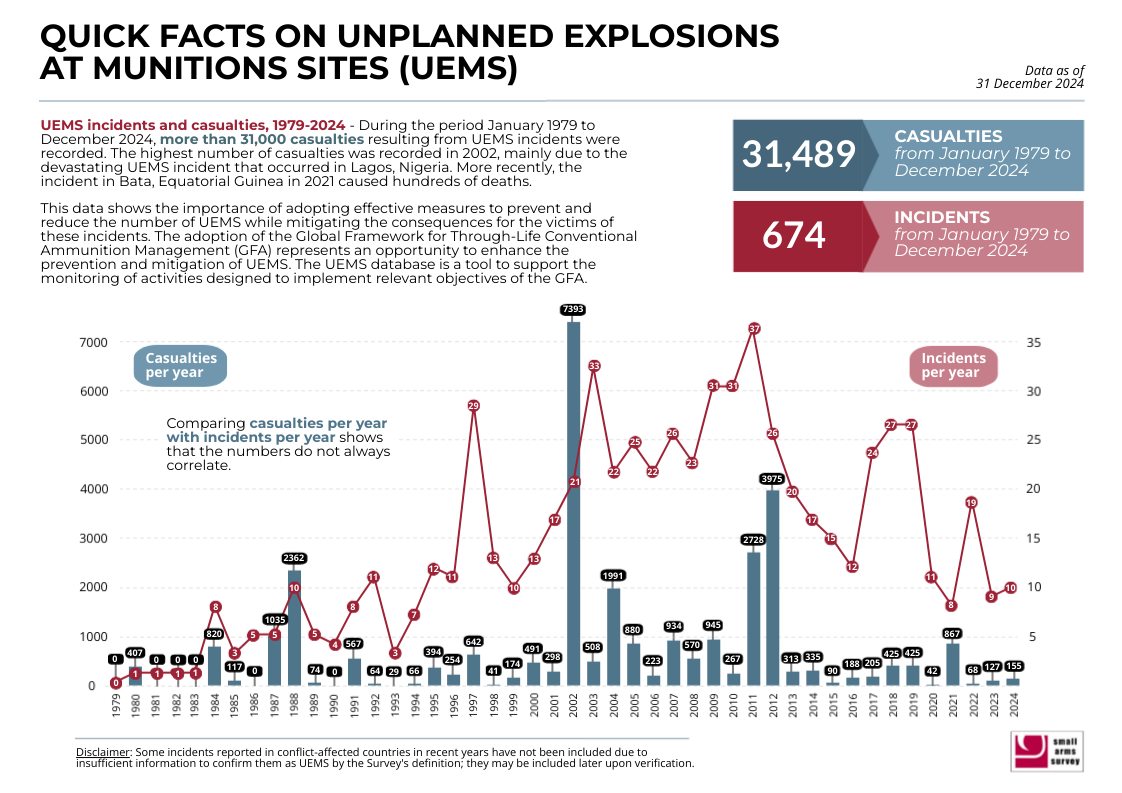
Research conducted by the Survey reveals that these incidents are widespread and increasingly common: in its database, the Survey has recorded 674 incidents between 1979 and December 2024.
The Small Arms Survey continues to maintain its UEMS database on an ongoing basis. To receive the full database of UEMS incidents in Excel format, please contact: media@smallarmssurvey.org.
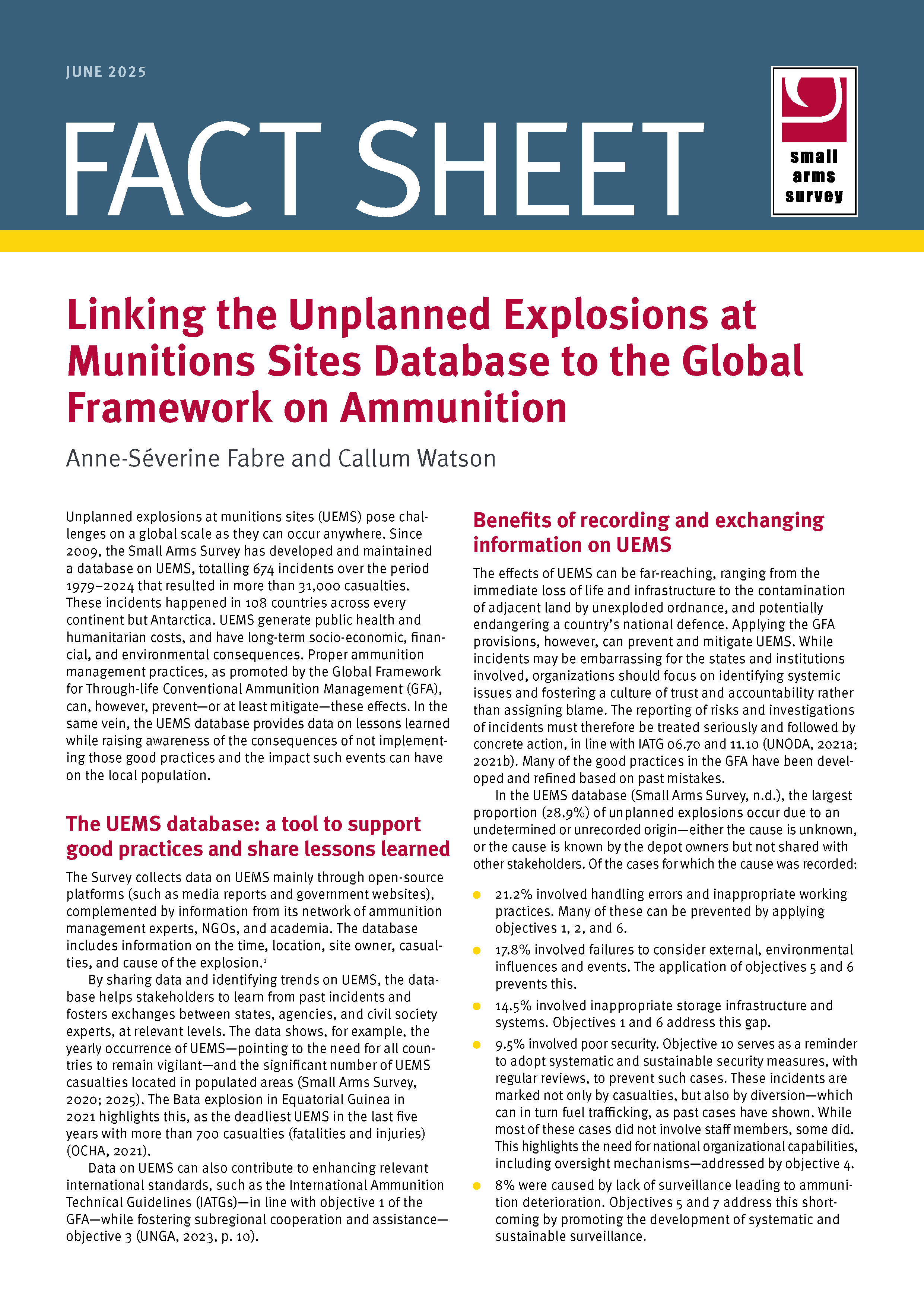
Check out our latest infographic and Factsheet below for a snapshot of the key findings, and the links between our UEMS database and the Global Framework on Ammunition. And scroll down to our interactive visualization tool below for a quick overview of the whole dataset:
Linking the Unplanned Explosions at Munitions Sites Database to the Global Framework on Ammunitionby Anne-Séverine Fabre and Callum Watson Factsheet | June 2025 English |
Quick facts on UEMS - January 2025 updateInfographic | January 2025 Arabic, English, Ukrainian |
Interactive Map (January 2025 update)
For more on UEMS, check out our other related outputs below and visit our Resource Library.
- Infographic (December 2021 - updated on 13 January 2022) in English
- Fact Sheet (March 2020) in English or French
- Infographic (March 2020) in English or French
- Fact Sheet (October 2019) in English or French
- Infographic (October 2019) in English or French
- Fact Sheet (April 2019) in English
- Infographic (April 2019) in English
Please welcome Susan Winters to Carpenter & Company!
Found 0 image(s):
Susan Winters has joined Carpenter & Company! She brings a wealth of knowledge and expertise in managing your Homeowners & Personal Auto Portfolio. Please give her a call or stop by to welcome her to the team!
West Bend - New Opportunity for Senior Living Facilities
Found 0 image(s):
West Bend Mutual Insurance is now offering General & Professional Liability coverage in addition to Property & Auto Liability coverage to Senior Living Facilities in Missouri. Please contact us today to see if they are a fit for your fa...
Ashley Armstrong returns to Carpenter & Company!
Found 0 image(s):
Today, we get to welcome back Ashley Armstrong back to Carpenter & Company! She is available to help you on your personal lines questions, please give her a call and welcome her back.
For Nursing Homes: The Importance of Screening Prospective Residents
Found 0 image(s):
We came across the following article today from our friends at GuideOne. It is a good reminder for Nursing Home administrators. The Importance of Screening Prospective Residents Most care facilities have measures in place to prevent resident a...
Welcome to our new website!
Found 0 image(s):
We've launched our new website, we hope you like it. We'll be adding and tweaking some things over the next few months, so if you have any ideas, please drop us a note. Happy New Year!End of feed